Thursday, February 7, 2013

RPG: In Defense of Skill Challenges

SPOILER ALERT: If you plan on running/playing Red Hand of Doom, by Rich Baker and James Jacobs, this blog makes reference to an event that occurs at the end of Part 1 (5 Parts total). Red Hand of Doom is one of the best written sandbox-style modules for DnD v3.5. If you haven't run it, you should.

-------

A common complaint about 4th edition DnD is that it reduced all roleplaying opportunities to skill checks via the Skill Challenge mechanic. You should never let a game tell you that you can't roleplay, but I understand where the concern comes from because I felt the same way. Then I started playing with the mechanic.

What I discovered was that when properly used, skill challenges enhanced roleplaying while keeping high stress situations, like sneaking into a dragon's lair, stressful. I never used them for important social interactions, like swaying a council to heed a warning about an oncoming horde, in the same way I'd never have let a single Diplomacy check persuade them, but physical challenges like chase scenes and social interactions with less important PCs became much more interesting.

Below is an example of a skill challenge I constructed for the 3rd edition module, "Red Hand of Doom", which I converted to 4th edition. In this scene, the players are escaping the burning town of Drellin's Ferry as its being overrun by a horde they could not stop. In the module, the scene is vaguely described (something like, 'as the PCs escape from the burning town, they must evade patrols'), but this skill challenge allowed the stress of the chase to build and gave the players multiple options if they succeeded.

House Rules: Small World Underground


One of the new elements in Small World: Underground are monsters that protect Popular Places and Righteous Relics. In the original Small World, a number of starting spaces contained a single tile of an ancient fallen race (known as Smurfs in our home games). In SWU, these starting spaces instead contain a pair of monster tiles. When the monsters are defeated, the player reveals a random token from a stack of Righteous Relics and Popular Places. These new monster tiles have one of seven images on them, but all monster tiles are mechanically identical, counting as two extra tiles you must defeat to take the space.

Why waste fun art?! It only took us one game to set up house rules for our critters and now it's time to share. It's a small world, after all.

Monday, December 31, 2012

Retro Review: 4th Edition DnD


It's important for any reviewer to do the following:

1) Get the game on the table and play
2) Remember that any game, no matter the system, is only as good as its players and DM
3) Speaking to D&D specifically: Remember that 1st edition players hated 2nd edition and 2nd edition players thought 3rd edition's skill system killed roleplaying.

I'm an old school, Fighting Man, white box gamer from 1978 and have seen the industry wax and wane over the decades. In many ways, I felt the same way about v3.0 back in 2000 as I did about my first look at 4th. A friend brought a copy of the 3rd ed Player's Handbook to a LARP I was running back in the day. I took one flip through and handed it back scoffing, "This isn't D&D."

Thursday, November 15, 2012

Partial Co-Op Horror: Betrayal at House on the Hill (3-6 players)


"Betrayal is an innovative, unpredictable and fun game, especially if you are a horror buff."

Betrayal at the House on the Hill is a partial co-op board game for 3-6 players, ages 12+, that draws its inspiration from classic horror stories; we've recently started calling it "Cabin in the Woods" The Boardgame.

Saturday, September 8, 2012

Gaming Gear: Maps of Mastery, Christopher West


"Chris West loves gaming and expresses that love with an artist's eye. Luckily for gamers, he shares that eye with the rest of us."

Back in the olden days of roleplaying, maps were crude scribblings on graph paper, dictated to the players by the Dungeon Master. Mapping caverns by hand gave you a feeling of exploration; you used your imagination to fill in the details of the surroundings that the DM described. Unfortunately, not everyone at the table imagined those same details.

Arguments were common about who was where, what was in the room and how close that ogre was to the brazier full of hot coals. Savvy DMs and players slipped around the arguments and kept the game moving, but it was always the most frustrating part of a session. There are times that I miss those days, mostly for the nostalgia of making due with what we had. Well, the day has finally come where we don't have to make due. We have Christopher West.

Saturday, August 18, 2012

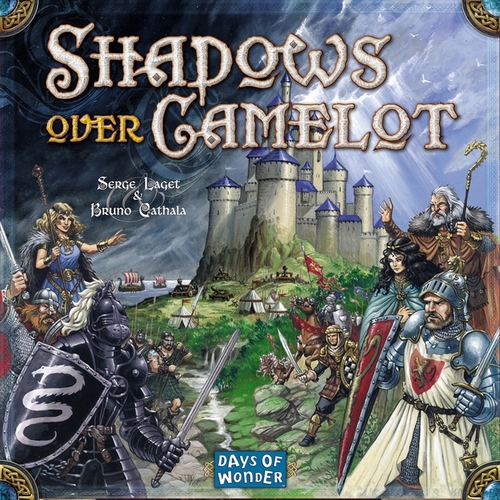
Co-Op Fantasy: Shadows Over Camelot (3-7+ players)


"Shadows remains one of the best cooperative games on the market."

Shadows Over Camelot is a cooperative game of epic fantasy for 3-7 players (8 with the Merlin's Company expansion), ages 10 and up. Players take on the roles of Knights of the Round Table, including King Arthur, Sir Galahad, Sir Percival and Sir Kay. These knights must work together to finish quests before Mordred completes his siege of Camelot.

Tuesday, August 14, 2012

Card Game: Edition Wars (3-5 players)


"Edition Wars is easy to learn, easy to teach and full of laughs."

When I first flipped through the short rulebook, my impression was that the game was too simple. Then I read the Gamemaster personalities, the Swag (equipment) cards and the Critical Effect cards and couldn't stop laughing.